Social media trends killing endangered orchids






Dikshya Dangol
Are you on any social media? If your answer is yes, here’s something you may want to read! Once primarily a platform for online social interaction, it has now transformed dramatically over the past decade, some changes for the better, others not so much. Today, social media and messaging apps have completely evolved from mere communication tools to powerful drivers of digital consumerism. Applications such as Facebook, YouTube, and TikTok are a few names.
Apps like TikTok with its social media trends have swept across the world and Nepal is no exception for it! From shaping lifestyles to providing a platform for free expression, has become one of the most popular apps among Nepalese with millions of users only in Nepal. With social media’s ability to amplify what’s new, even the most niche fascinations are quickly becoming mainstream. Its users follow viral trends; aesthetics often tap into the “fear of missing out” on the global sensation. A clear example of it is the “Labubu Plush toy craze”. These collectibles went viral through “unboxing trends” and “rare edition reveal” in TikTok which caused a frenzy, with some enthusiasts even willing to pay triple the retail price for a “secret” Labubu. It’s clear that many users are drawn into these trends, chasing short-term online hype while rarely considering the long-term value or the potential consequence.
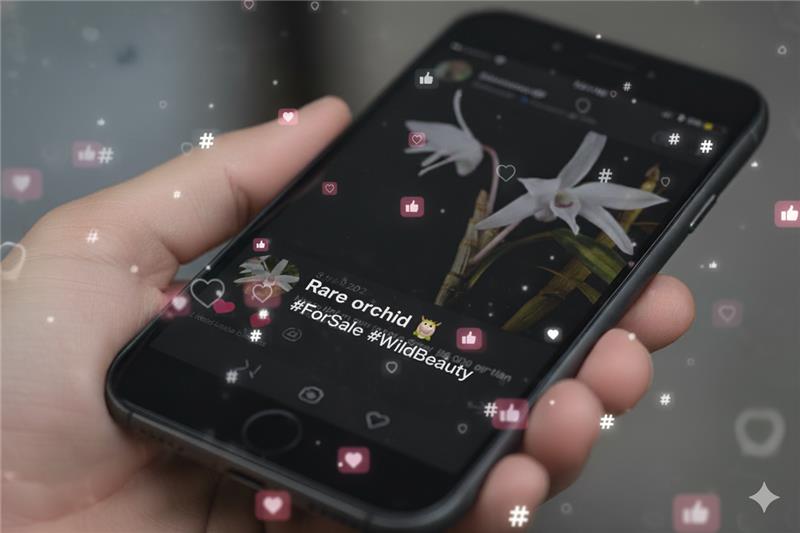
Among such viral trends, concerning trends has emerged, the illegal harvesting of wild plants, in particular, orchids. Tempted by orchids’ rarity and decorative appeal, many people seem to be collecting wild orchids directly from nearby forests, replanting them at home and posting them on their social media. According to Nepal’s domestic CITES regulations, this practice is strictly illegal. Yet, despite the law, social media trends continue to grow as these orchids, and their magnificent blooms can go viral in no time!
Orchids are famous across the world for their fragrance, long-lasting blooms, and vibrant colors. Their appeal makes them a favorite among plant enthusiasts and collectors. But in recent times, the growing TikTok trend in Nepal for Orchid has started to blur the line between admiration and exploitation from wild habitat – which is a serious threat to this protected wildlife.
Recently, I came across a post on TikTok where a person was showing the blooming fox tail orchid in the jungle. But right after, she was seen uprooting the plant straight from the forest to her home to replant. When some people pointed out that this was against the law in her video, she defended herself, with comments that “It’s just a plant from the jungle.” The response is alarming, but it made me think, can we do something to turn this obsession with wild plants into a conservation mindset?
Although it seems “just a single plant out of the jungle”, our naive actions have a much bigger impact. What makes it even more concerning is how such actions, when shared on online platforms, can influence hundreds of viewers to do the same. And, if that person is an influencer, it’s even worse. Few commentors were even influenced by doing so from their nearby jungles.
The reality is, taking wild orchids and harvesting them at home or any plants even in small numbers from their natural habitat is concerning, and people don’t seem to realize that it directly threatens local biodiversity. When influenced by such behavior, more people start harvesting orchids unsustainably and it doesn’t take long for overexploitation to set in which can cause a rapid decline of these orchids in the wild.
Foxtail orchids (Rhyncostylis ratusa) are among the most targeted wild orchids on platforms like TikTok because of their attractive flowers and high popularity online. Other orchid species such as Dendrobium spp. and Coelogyne spp. are also popular on websites involved in the trade of medicinal plants. The real challenge in addressing this issue isn’t only about stopping individuals in the forest; it’s the vast unregulated online market. On top of that, such platforms make it incredibly difficult to track such activities, even though they clearly go against laws. Sadly, this also reveals loopholes in our law enforcement for such plants and how easily the conservation of such unique plants is overlooked.
The impact of online hype leading to exploitation of species is staggering. Take the case of Paphiopedilum canhii, a slipper orchid species that was pushed to report near extinction within just six months of its record, thanks largely to online hype (Mongabay, 2018). However, later, a new patch was recorded. When online plant collectors catch the wind of a “new” plant, demand skyrockets long before its cultivation methods can catch up. A simple listing and posting of its photo for viral trends and aesthetics can trigger the removal of wild orchid plants. The irony is hard to ignore while apps like Facebook, Instagram, TikTok thrive on fleeting trends; the damage they amplify is lasting. If left unchecked, these “viral trends” could end up being lost to the very platforms that popularized them. A similar pattern can be observed in Nepal, where TikTok users have popularized hashtags such as #wildorchids and #rareorchid, often showcasing orchids taken directly from the forest. In such cases sellers or normal TikTok users don’t always bother to hide their sources; in fact, all of them proudly post photos of orchids ripped straight from the forest. And because legitimate sellers also operate in the same TikTok spaces, there is no clear distinction between legal and illegal trade in online platforms.
What starts as a trend or an attempt to gain likes and followers, could ripple out into real forests, stripping ecosystems of irreplaceable species. Orchids aren’t just decorative; they’re keystone plants that support pollinators, fungi, and forest systems. If digital hype continues unchecked, the viral trend erases such precious species from our forests.
Joining Greenhood marked my first deep dive into orchids, and it opened my eyes to how critical these species are for maintaining biodiversity. Before this, I never truly considered how our everyday actions, seemingly small and disconnected, can have profound impacts on ecosystems. Social media, which I’ve always viewed as a platform for self-expression and connection, revealed its other side through my research on online illegal trade. It became clear how these same digital spaces that bring us together can also facilitate exploitation and harm. Over these past three months, I’ve encountered the deep-rooted complexities of research work and realised how often we fail to address these issues with the urgency and thoughtfulness they demand. This experience has fundamentally shifted how I understand research and the complex role social media plays in both harming and helping these efforts.
(Dikshya Dangol is a research intern at Greenhood, looking into illegal wild orchid trade in Nepal.)
References:

⟟ Balephi 08, Sindhupalchok AND ⟟ Kathmandu 02, Baluwatar
45305
Nepal
Telephone: +977-1-4504444
Email: info@greenhood.org
© 2021 Greenhood Nepal - Registered Charity Number 34885